Sudoku looks complicated when you look at it from outside. Nine rows, nine columns, nine three-by-three blocks, numbers scattered around the board, and the feeling that there is a hidden rule somewhere. There is not. Sudoku is the simplest game there is. It has one rule. And once you understand the rule, you know how to play forever.
The rule is this. The board has nine rows, nine columns and nine three-by-three blocks. You have to fill the empty cells with numbers 1 to 9, without repeating any number in any row, in any column or in any block. That is it. Each row must contain 1, 2, 3, 4, 5, 6, 7, 8 and 9. Each column too. Each block too. When all 81 cells are filled following this rule, the puzzle is done.
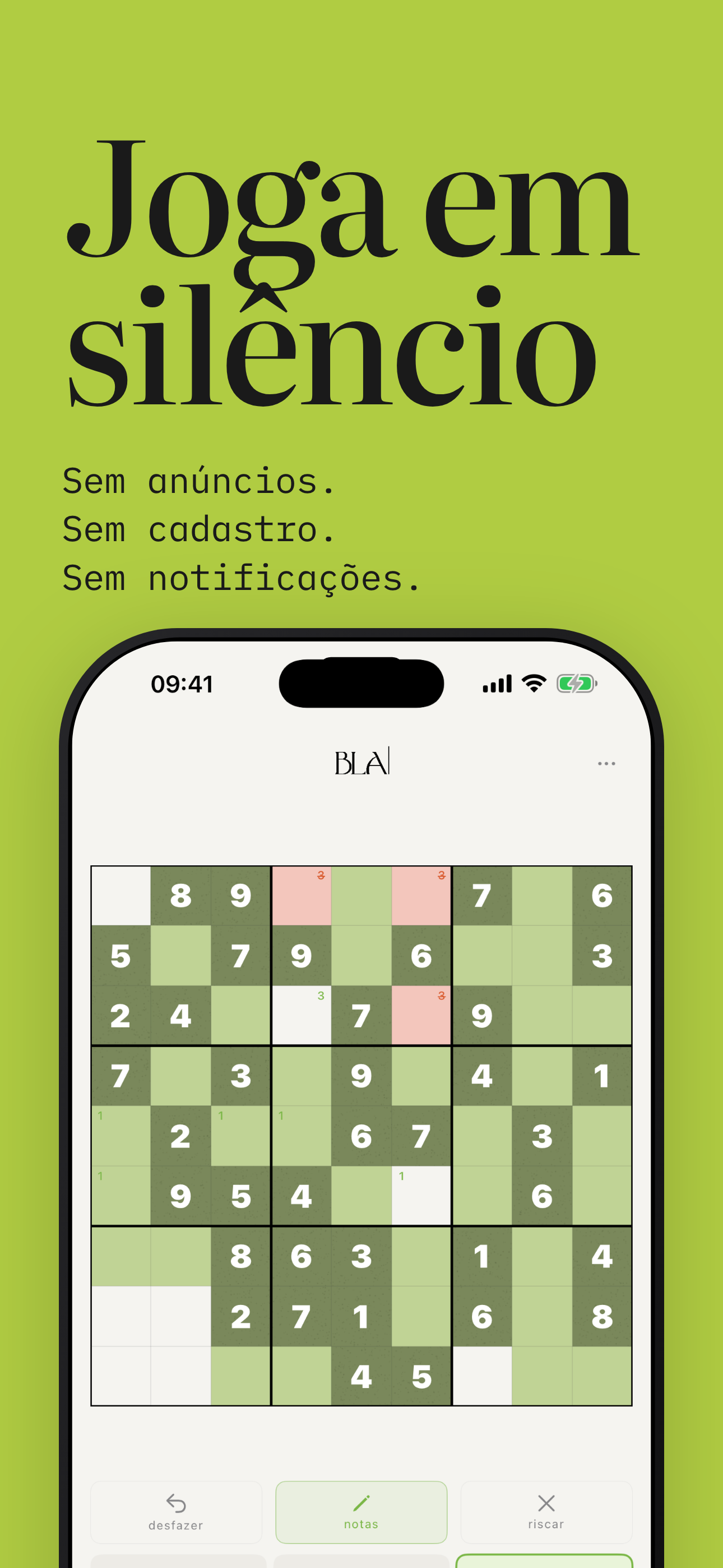
Before you start, scan the board. Look at each row, each column, each block. Sudoku is a game of elimination. You do not need to guess anything. Every new number you place must have a logical justification. If you are guessing, you are playing it wrong.
The first technique is the simplest: find the cell that can only hold one number. Look at an empty cell, see every number already present in the same row, the same column and the same block. When only one possibility is left, that is the number that goes there. Start with blocks that already have many filled cells. They give faster clues.
The second technique is to look at the row, column or block that is almost complete. If a row already has eight numbers filled, the ninth is easy: it is the one missing between 1 and 9. Same for the column. Same for the block. Identify those areas and close them first. Each number you close makes the rest easier.
When you get stuck, switch to taking notes. Any decent Sudoku app lets you place small marks inside a cell with the numbers that are still possible there. Mark all candidates. Keep eliminating as new numbers enter the board. Soon enough, the notes point you to the next move on their own.
If you are starting out, play the easy level until the three techniques above become automatic. Each new level adds a deduction layer. In medium, you start needing techniques like naked pair and hidden pair. In hard, X-wing shows up. In expert, techniques that take time to internalize. But the base is always the same: scan, eliminate, take notes.
Sudoku is a slow game. There is no enemy timer. You play at your pace. You finish when you finish. And when you finish, you close the app, take a breath, open another puzzle. Not addictive in the bad sense. Addictive in the sense of someone who has just read Sherlock Holmes and wants one more case.
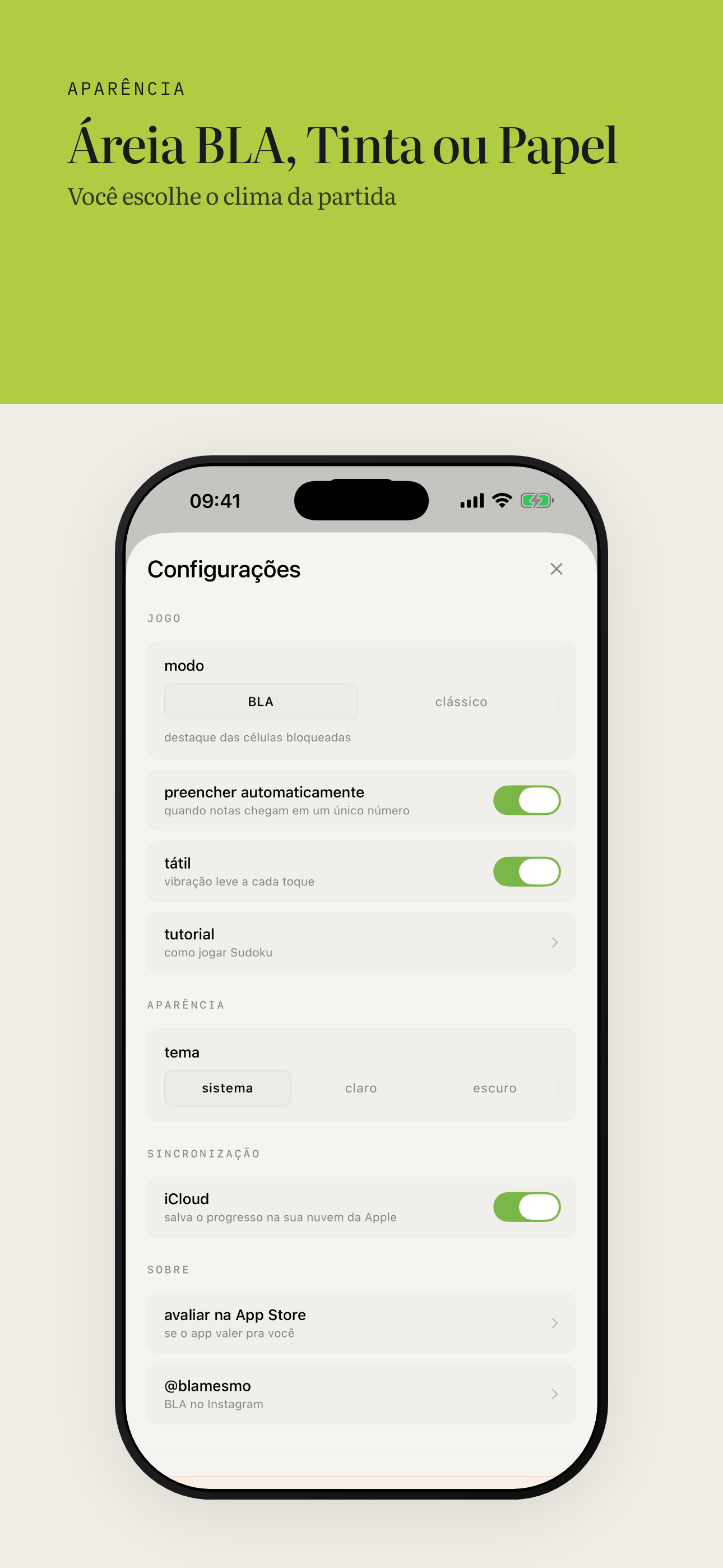
To learn Sudoku, get an app that does not get in your way. Sudoku BLA has eight thousand puzzles across four levels, works offline, runs on iPhone, iPad and Mac. No ads, no login, no distraction. You open it, choose a level, start. The game teaches you on its own, round after round. The rest of the career is just closing one more puzzle.